





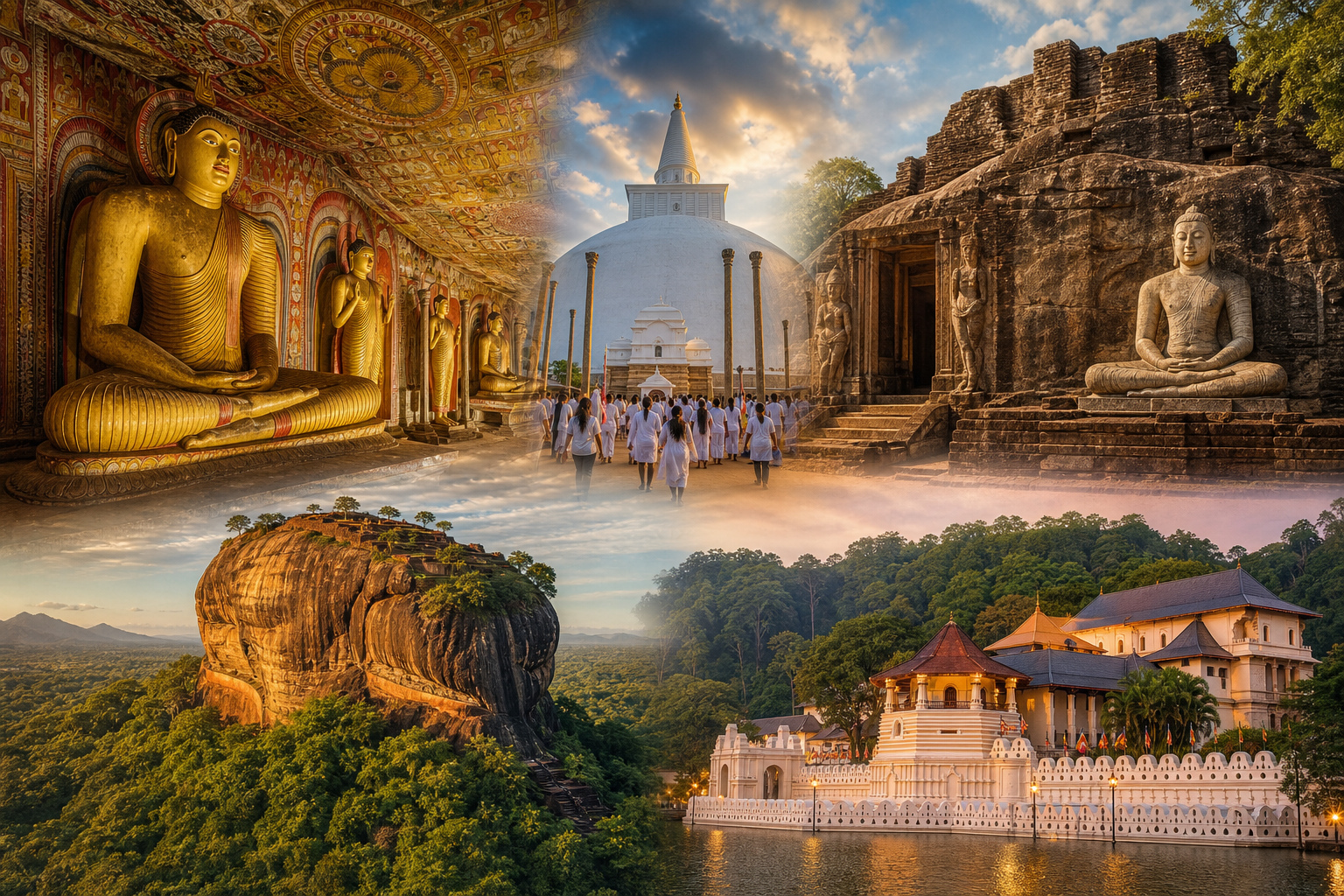
The Cultural Triangle in Sri Lanka isn’t a checklist, it’s a slow unraveling of history. Kingdoms rose and fell here long before most of Europe figured itself out, and the evidence is still standing: cave temples filled with centuries-old paintings, and cities reclaimed by jungle.
The mistake most travelers make is rushing through it. Distances look short on a map, but the heat, the scale, and the sheer density of sites force you to slow down. That’s a good thing.
This route connects five of the most important places, not just because they’re famous, but because together they tell a complete story.
1. Anuradhapura, $30
Anuradhapura doesn’t ease you in, it overwhelms you.
This was Sri Lanka’s first great capital, founded over 2,000 years ago, and it feels like an open-air museum stretched across miles. You don’t “visit” Anuradhapura so much as move through it.
The ruins are scattered: massive brick stupas rising out of flat plains, monastic complexes, ancient reservoirs, and sacred trees. The Sri Maha Bodhi, grown from a cutting of the tree under which Buddha is said to have attained enlightenment, is still actively worshipped today.
That’s what makes Anuradhapura different from other archaeological sites: it isn’t dead. Pilgrims in white clothing move quietly between shrines, leaving flowers and lighting incense. You’re walking through both history and living religion at the same time.
Rent a bicycle. Trying to cover it on foot in the heat is optimistic at best.
Don’t try to see everything, you can’t. Focus on a handful of key sites like Ruwanwelisaya, Jetavanaramaya, and Abhayagiri, then let yourself wander between them.
It’s less about ticking off monuments and more about absorbing scale. Few places make you feel small in quite the same way.
2. Sigiriya (Lion Rock), $35
Sigiriya is the one you’ve already seen, even if you don’t realize it yet.
A massive rock fortress rising abruptly from the jungle, crowned with the ruins of a 5th-century palace. It’s often called the “Eighth Wonder of the World,” which sounds exaggerated until you’re halfway up.
The climb is part of the experience. You pass through landscaped water gardens, climb spiral staircases to reach ancient frescoes, and walk between giant lion paws carved into stone. From there, it’s a final push to the top.
And yes, it’s hot, crowded, and not cheap.
But it delivers.
At the summit, you’re standing where a king once ruled, surrounded by panoramic views of forest stretching endlessly in every direction. It’s one of those rare places that actually lives up to the hype.
A few tips that make a big difference:
- Go early (as close to opening as possible)
- Bring water, more than you think you need
- Take your time on the way up; it’s not a race
The ticket includes access to the museum, which most people skip. Don’t. It gives context that turns a pile of ruins into something much more meaningful.
3. Dambulla Cave Temple, LKR 2,000–3,000 (= $10)
Dambulla is easy to underestimate, right up until you reach the caves.
From the base, it’s a short but sweaty climb up a rock outcrop. At the top, five cave temples open up, each filled with hundreds of Buddha statues and walls covered in intricate paintings.
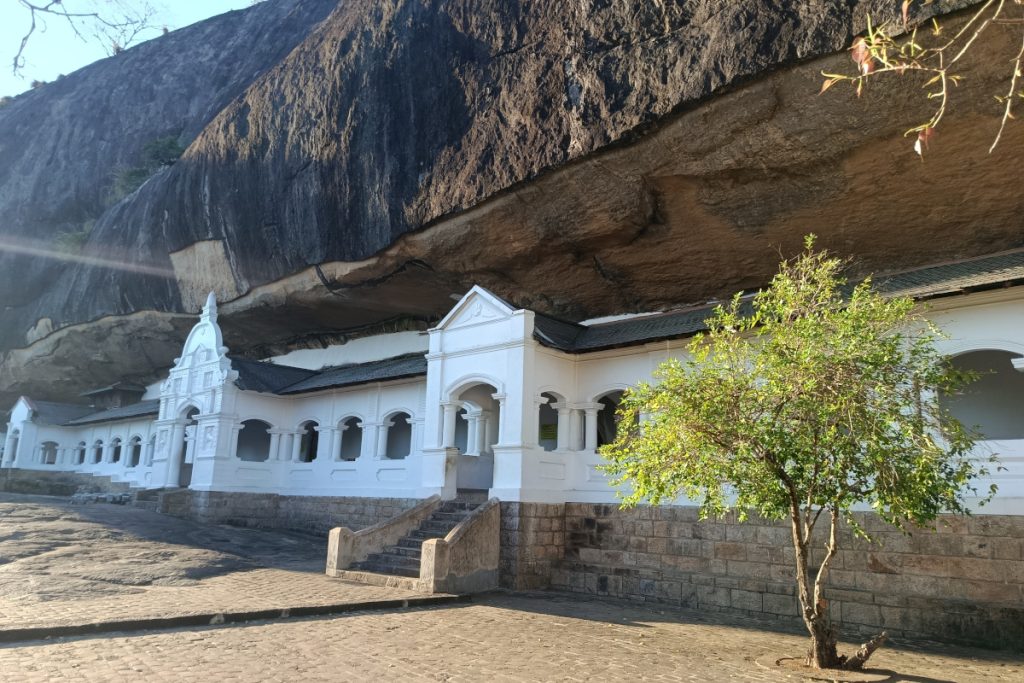
Some of these date back over 2,000 years.
The ceilings are what stay with you. Every inch is painted, patterns, figures, stories layered over centuries. It feels dense, almost overwhelming, like stepping inside a living piece of art.
There’s no glass, no barriers separating you from it. You’re right there, walking through it.
The site has been used continuously since the 1st century BC, evolving through different kingdoms including Anuradhapura and Kandy. (en.wikipedia.org)
Go in the late afternoon if you can. The light softens, the crowds thin out, and the views across the plains, with Sigiriya visible in the distance on a clear day, add something extra.
Remember:
- Shoes off (bring socks, the ground gets hot)
- Dress modestly
- No photos with your back to Buddha statues
It’s smaller than the other sites, but it lingers longer than you expect.
4. Polonnaruwa, $30
If Anuradhapura feels sprawling and chaotic, Polonnaruwa feels composed.
This was Sri Lanka’s medieval capital, and the layout is far more structured. The ruins are better preserved, the roads more navigable, and the overall experience easier to digest.
It’s still large, don’t mistake that, but it’s manageable.
Again, rent a bicycle.
The highlights come in clusters:
- The Royal Palace complex
- Quadrangle (a tight concentration of beautifully detailed ruins)
- Gal Vihara, a group of massive Buddha statues carved directly into rock
Gal Vihara alone is worth the trip. The reclining Buddha, carved from a single slab of granite, has a calmness that’s hard to explain. It’s simple, but precise in a way that makes it feel alive.
Compared to Sigiriya, Polonnaruwa is quieter. Compared to Anuradhapura, it’s more approachable.
Give yourself at least half a day. More if you’re not in a rush.
5. Kandy, Temple of the Tooth: $5
Kandy is where the Cultural Triangle shifts tone.
After days of ruins and ancient cities, you arrive somewhere that feels more like a living urban center, set around a lake, surrounded by hills, and anchored by one of the most important religious sites in the country.
The Temple of the Sacred Tooth Relic is the main draw. It houses what is believed to be a tooth of Buddha, making it one of the most sacred places in Sri Lanka.
You don’t actually see the relic itself, it’s kept inside a series of ornate caskets, but that’s not really the point.
Visit during a puja ceremony. Drums, chanting, and a steady flow of devotees create an atmosphere that’s far more intense than a typical sightseeing stop.
It’s crowded, a little chaotic, and deeply authentic.
Outside the temple, Kandy offers a different pace:
- Walk around Kandy Lake at sunset
- Explore small markets and backstreets
- Catch a cultural dance performance if you’re curious (touristy, but still interesting)
After the scale of the Cultural Triangle, Kandy feels almost like a reset.
What the Cultural Triangle in Sri Lanka Really Costs
Let’s be direct, this region isn’t cheap.
The main heritage sites are managed by the Central Cultural Fund, and foreigner ticket prices are fixed in USD:
- Sigiriya: ~ $ 35
- Anuradhapura: ~ $ 30
- Polonnaruwa: ~ $ 30 (ccf.gov.lk)
- Dambulla: ~ LKR 2,000–3,000
- Temple of the Tooth (Kandy): ~ $ 5
It adds up quickly.
There’s no real way around it unless you skip sites, and skipping them defeats the purpose of coming here.
The better approach is to accept it upfront and plan your days so you’re not rushing through places you paid to see.
How to Approach the Cultural Triangle in Sri Lanka
Most people base themselves in Sigiriya, Dambulla, or Habarana and take day trips. It works well and keeps travel time manageable.
A typical route:
- Day 1: Dambulla + Sigiriya
- Day 2: Polonnaruwa
- Day 3: Anuradhapura (early start)
- Day 4: Travel to Kandy
Start early every day. The heat builds fast, and by midday it becomes draining.
Why The Cultural Triangle in Sri Lanka Stands Out
It’s not just the ruins, it’s the continuity.
In many countries, ancient sites feel disconnected from modern life. Here, they’re still part of it. People worship in temples built over 2,000 years ago. Monks walk past tourists. Offerings are placed in front of structures older than most civilizations still remembered.
You’re not just looking at history, you’re moving through something that never fully stopped.
And that’s what makes the Cultural Triangle stick with you long after you leave.
Learn more about Sri Lanka
- 4 Lessons
- 2 Students
Learn about Sri Lanka and turn your wanderlust into a well-planned adventure, travel smarter, cheaper, and with less stress.
- Know what you need to know
- Avoid rookie mistakes
- Tools to plan like a pro
- Unlock hidden gems