





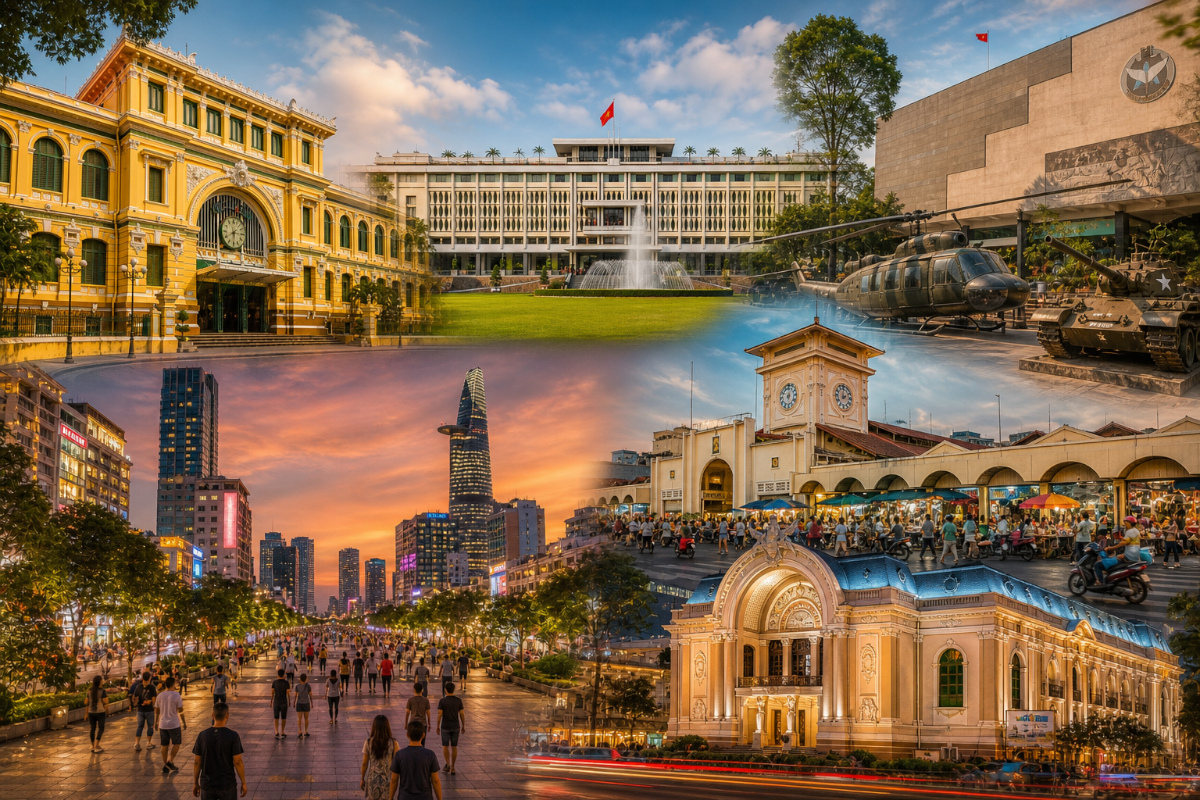
A Ho Chi Minh City walking tour is the best introduction to Vietnam’s largest metropolis. Yes, the traffic is chaotic, the humidity can feel like a wet blanket, and the pavements occasionally disappear beneath parked motorbikes. But walking lets you experience details you’ll miss from a taxi: incense drifting from a hidden shrine, vendors cutting fruit in narrow alleys, faded colonial façades, and tiny coffee shops tucked above busy streets.
This route focuses on five essential stops in and around the historic centre. It is approximately five kilometres long, depending on detours, and can fill most of a day if you enter the museums. Start early, wear light clothing, bring water, and don’t attempt to defeat the tropical heat through willpower alone. Regular coffee and food breaks are part of the itinerary.
1. Saigon Central Post Office
Begin your Ho Chi Minh City walking tour at the Saigon Central Post Office, one of the most striking remnants of the city’s French colonial period.
Its bright yellow façade, green shutters and decorative arches make it an obvious photography stop, but the interior is even better. Step through the entrance and you’ll find a long, vaulted hall with patterned tiles, old maps and wooden telephone booths. Unlike many historic landmarks, this is not simply a preserved building: it continues to operate as a post office.
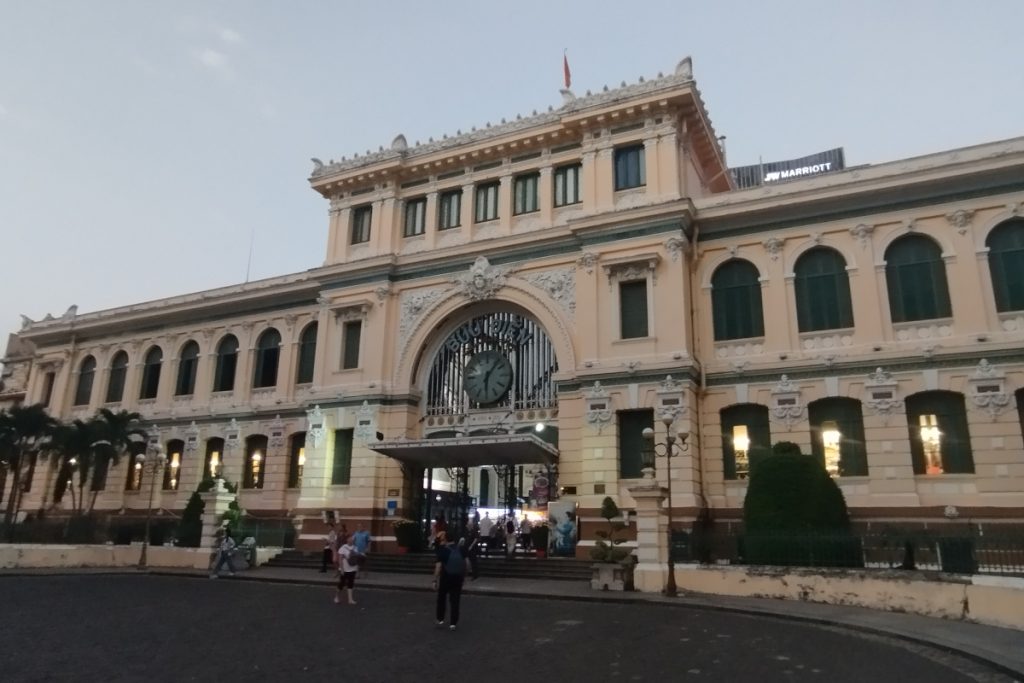
That everyday function gives the place character. Travellers browse postcards beside residents sending parcels, while clerks work behind counters beneath the grand ceiling. Buy a postcard, write it at one of the desks and send it home. It is inexpensive, slightly old-fashioned and more memorable than another souvenir T-shirt.
The post office is frequently associated with Gustave Eiffel, but the building’s design history is more complicated than that popular claim suggests. Instead of concentrating on the famous-name story, appreciate the building for what it reveals about colonial Saigon: European architectural ideas adapted, sometimes imperfectly, to a Southeast Asian city.
Arrive shortly after opening if you want clear photographs and fewer tour groups. Entrance is normally free, although postcards, stamps and souvenirs cost extra.
Directly opposite stands the red-brick Notre-Dame Cathedral Basilica of Saigon. Restoration work may affect access, so regard the exterior as the main attraction unless local signs indicate otherwise. The post office and cathedral form the city’s most recognizable colonial-era pairing, and Vietnam’s official tourism site recommends seeing them together in the morning.
Before moving on, walk along nearby Nguyen Van Binh Book Street. Its shaded stalls and cafés provide a welcome break from the surrounding traffic.
2. Independence Palace
From the post office, walk along Le Duan Boulevard and turn toward Independence Palace, also called Reunification Palace. The journey takes roughly 10–15 minutes, but allow extra time for crossings.
The palace is among the most important historical buildings in modern Vietnam. It served as the presidential residence and workplace of South Vietnam and became an enduring symbol of the war’s conclusion when tanks entered its grounds on April 30, 1975.
What makes the building fascinating is how little it resembles a stereotypical royal palace. Designed in a modernist style, it is filled with formal reception rooms, government offices, diplomatic chambers and private apartments. Much of the interior feels suspended in the 1960s and 1970s.
Do not rush straight through the ceremonial rooms. Look at the furniture, communications equipment and architectural details. The airy upper floors contrast sharply with the underground bunker, where narrow corridors connect map rooms, radio facilities and operational spaces. That movement from bright ceremonial architecture to utilitarian wartime rooms helps explain the building better than a simple list of historical dates.
The palace is currently open daily from 7am to 6pm, except on special occasions. Since May 1, 2026, combined adult admission for the palace and accompanying exhibition has been 80,000 VND, while a palace-only adult ticket costs 40,000 VND. Check the official site before visiting because arrangements can change. (dinhdoclap.gov.vn)
Allow 90 minutes for your visit. The grounds provide some shade, but much of the building is naturally ventilated rather than aggressively air-conditioned. Bring water.
This is the stop that gives a Ho Chi Minh City walking tour its historical backbone. Without it, the surrounding boulevards are attractive; after visiting, they become part of a much larger political story.
3. War Remnants Museum
The War Remnants Museum is about a 10-minute walk from the palace. Although geographically close, it demands a major emotional shift.
Outside, the museum displays aircraft, tanks and artillery. Inside, its exhibitions use photographs, documents and personal stories to examine the Vietnam War and its consequences. Collections cover subjects including wartime journalism, civilian suffering, imprisonment and the effects of Agent Orange.
Many images are graphic. This is not an attraction to squeeze into a spare 20 minutes or treat as a backdrop for cheerful photographs. Give the displays your attention, and give yourself permission to step outside when necessary.
The museum presents history primarily through a Vietnamese lens. Some travellers react by labelling the presentation one-sided and moving on. A more useful response is to consider why national museums tell stories in particular ways, whose voices were historically amplified, and whose suffering was minimized. You do not need to accept every curatorial decision uncritically to understand the value of encountering this perspective.
The museum holds more than 20,000 documents, photographs, films and artefacts. It is open daily from 7:30am to 5:30pm, including holidays, although the ticket counter closes at 5pm. General admission is currently 40,000 VND.
Plan for at least 90 minutes. Two hours is better if you read most of the captions. Travellers with young children should preview the nature of the exhibitions before entering.
Afterward, stop somewhere quiet for lunch. This is an important practical point: a Ho Chi Minh City walking tour should leave breathing room after emotionally demanding places. Find cơm tấm, bánh mì or a bowl of phở, sit in the shade, and allow the experience to settle before continuing.
4. Ben Thanh Market
Walk south toward Ben Thanh Market, one of central Saigon’s most famous commercial landmarks. The building and clock tower are instantly recognizable, but the real attraction is the dense maze inside.
Stalls sell coffee, tea, spices, dried fruit, clothing, lacquerware, textiles, kitchen goods and souvenirs. You will also encounter prepared-food counters where cooks work within remarkably small spaces.
Ben Thanh is undeniably touristy. Prices can start high, sellers can be persistent, and identical products often appear at several stalls. That does not make the market worthless; it simply means you should approach it with realistic expectations.
Walk around once before buying. Compare prices, inspect quality and bargain with a smile. If the negotiation stops being enjoyable, politely leave. Saving the equivalent of one dollar is not worth turning a human interaction into a battle.
Keep your phone and wallet secure in crowded aisles. Carry a small amount of accessible cash rather than opening your entire wallet whenever you pay. For food, choose busy counters where ingredients move quickly, and watch how dishes are handled before ordering.
Ben Thanh brings noise, colour and commercial energy to the Ho Chi Minh City walking tour. Even if you buy nothing, spend 30–45 minutes observing how the space works.
5. Nguyen Hue Walking Street and the Opera House
Finish by heading toward Nguyen Hue Walking Street, passing elegant remnants of old Saigon along the way. If you have energy, detour via Dong Khoi Street and the Saigon Opera House.
The Opera House is one of the centre’s architectural highlights. Even if you do not attend a performance, its ornate exterior deserves a closer look. Nearby stand historic hotels, expensive boutiques and polished cafés, creating a sharp contrast with the compressed intensity of Ben Thanh Market.
Continue to Nguyen Hue, a broad pedestrian boulevard extending from the People’s Committee Building toward the Saigon River. Official tourism itineraries connect Nguyen Hue with Dong Khoi, the Opera House, the cathedral and Central Post Office as a natural circuit through the historic centre.
Nguyen Hue is pleasant during the day but comes alive after sunset. Families gather, teenagers practise dance routines, vendors appear and the surrounding buildings illuminate. Find a bench and watch the city instead of immediately searching for another attraction.
You will also see the famous Café Apartments, an old building whose balconies contain cafés and small businesses. Going inside can be fun, but it is not obligatory. The exterior view from the boulevard is the most memorable part, especially after dark.
Ending here gives your Ho Chi Minh City walking tour a satisfying progression: colonial architecture, wartime history, market commerce and contemporary public life.
Practical Route for this Ho Chi Minh City walking tour and Final Advice
Follow this order:
- Central Post Office and Notre-Dame Cathedral
- Independence Palace
- War Remnants Museum
- Ben Thanh Market
- Opera House and Nguyen Hue Walking Street
Start between 7:30am and 8am and finish around sunset. Avoid the harshest heat with a long lunch or coffee break. When crossing roads, move steadily, remain predictable and avoid suddenly stepping backward. Watch local pedestrians and cross beside them until you become comfortable.
Most importantly, remain flexible. The best Ho Chi Minh City walking tour is not measured by how efficiently you collect landmarks. It is defined by the details between them: an unexpected temple, a plastic stool beside a food cart, a beautifully weathered doorway or a strong iced coffee when the heat finally wins.
Learn More about Vietnam
- 4 Lessons
- 0 Students
Learn about Vietnam and turn your wanderlust into a well-planned adventure, travel smarter, cheaper, and with less stress.
- Know what you need to know
- Avoid rookie mistakes
- Tools to plan like a pro
- Unlock hidden gems