





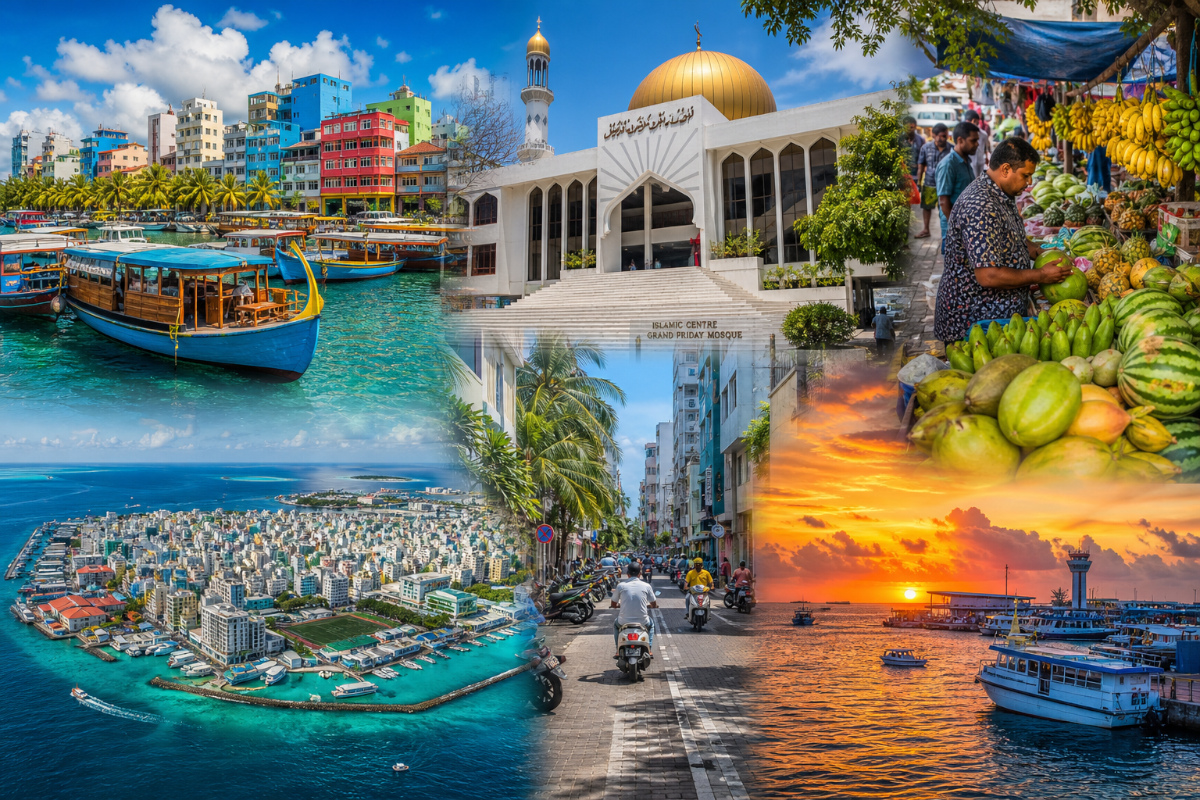
A Malé walking tour reveals a side of the Maldives that glossy resort brochures rarely show. Instead of overwater villas and empty beaches, the capital offers crowded streets, colourful apartment blocks, busy markets, historic mosques and fishing boats unloading the day’s catch.
Malé is compact, relatively flat and easy to explore without transportation. However, the tropical heat, heavy traffic and narrow pavements can make even a short route tiring. Start early, carry water and plan a café stop during the hottest part of the day.
The five stops below can be covered in three or four hours, but allow most of a day if you want to visit the museum, eat lunch and wander through the markets. Dress conservatively, particularly when approaching mosques: shoulders and knees should be covered.
1. Republic Square and the Islamic Centre
Begin your Malé walking tour at Republic Square, also known as Jumhooree Maidhaan. Located beside the waterfront, this small public space provides an easy introduction to the capital.
A giant Maldivian flag dominates the square, while government buildings and security headquarters surround it. Locals use the area as a meeting point, and ferries move through the harbour nearby. It may not take long to explore, but it helps you understand Malé’s role as the political and administrative centre of the country.
The square’s main architectural landmark is the Islamic Centre. Opened in 1984, the complex contains a conference hall, library and the Grand Friday Mosque, which is named after Maldivian national hero Sultan Muhammad Thakurufaanu Al Auzam. Its golden dome has become one of the capital’s most recognisable features.
Non-Muslim visitors may sometimes enter outside prayer periods, but access is not guaranteed. Ask permission, remove your shoes and dress respectfully. Even when the mosque is closed to visitors, the exterior is worth seeing.
The building looks particularly impressive from the waterfront, where its dome rises above Malé’s tightly packed concrete skyline. That contrast, monumental religious architecture surrounded by modern congestion, captures the city’s character surprisingly well.
Before continuing, walk along the harbour for a few minutes. The constant movement of ferries, delivery boats and speedboats is a reminder that almost everything used in the Maldives must travel between islands.
2. Hukuru Miskiy, Mulee’aage and Medhu Ziyaaraiy
From Republic Square, walk east toward Hukuru Miskiy, commonly called the Old Friday Mosque. It is only a short distance away, but take your time: the surrounding streets contain government buildings, small shops and glimpses of everyday city life.
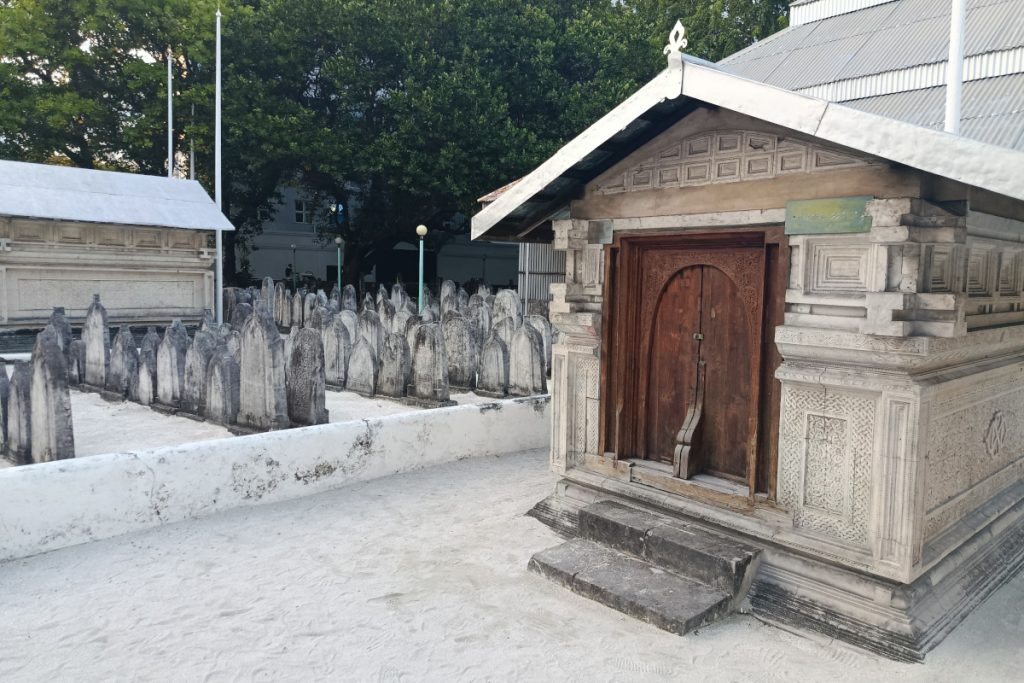
Built in 1658, Hukuru Miskiy is constructed from interlocking coral-stone blocks decorated with detailed carvings. Its interior contains traditional woodwork and lacquer decoration, while the adjacent minaret dates from 1675. A seventeenth-century cemetery surrounds the mosque, with elaborately carved coral tombstones marking the graves of former rulers and prominent citizens.
This is one of the most culturally important stops on any Malé walking tour. The mosque does not have the enormous scale of the Islamic Centre, but its craftsmanship is far more distinctive. Remember that it remains an active religious site rather than a conventional tourist attraction. Visitors should seek permission before entering and avoid disturbing worshippers.
Across the road stands Mulee’aage, the official presidential residence. The building’s decorative façade, painted in blue and white, can be admired from the street, although the residence itself is not generally open for casual sightseeing.
Nearby is Medhu Ziyaaraiy, a small shrine associated with Abu al-Barakat Yusuf al-Barbari, the figure traditionally credited with introducing Islam to the Maldives. The shrine is modest and easy to overlook, but its significance becomes clearer when viewed alongside the historic mosque and presidential residence.
Together, these three landmarks form Malé’s most interesting historic cluster. Spend time examining the doors, walls and carved details instead of simply taking a photograph and moving on.
3. Sultan Park and the National Museum
Continue toward Sultan Park, one of the capital’s most welcome patches of greenery. Malé is intensely developed, so even a relatively small garden feels like a retreat after walking beside motorbikes and closely packed buildings.
The park occupies land that was once part of the former royal palace grounds. Shaded paths, tropical plants and seating areas make it a practical place to rest. Depending on current access arrangements, an admission fee may apply, so check locally before entering.
Next to the park is the National Museum, the best place to learn about Maldivian history beyond tourism and beaches. The original museum opened in 1952, while the present museum building opened in 2010. Its collections cover the country’s pre-Islamic period, Islamic heritage, monarchy, craftsmanship and political development.
Displays have included royal clothing, historic weapons, household objects, coins, religious artefacts and examples of Maldivian lacquer work. The collection helps explain how geography shaped the country. Long before seaplanes and luxury resorts arrived, Maldivians were skilled sailors, traders, fishermen and boatbuilders connected to commercial routes across the Indian Ocean.
Allow at least an hour inside. The displays may not be as extensive as those in major international museums, but they provide essential context. Without this stop, it is easy to leave the capital having seen buildings without understanding the society that created them.
On a hot afternoon, the museum also provides something every traveller eventually appreciates: a break from the sun.
4. Malé Local Market and Fish Market
No Malé walking tour is complete without exploring the waterfront markets. Head northwest from the museum toward the commercial harbour, where the atmosphere becomes noisier and more energetic.
Start at the local market, where vendors sell bananas, coconuts, papayas, vegetables, spices, dried fish and packaged snacks. Much of the produce arrives by boat from agricultural islands elsewhere in the country. The market offers a useful look at the logistics of supplying a densely populated capital built on a small island.
This is a good place to try a coconut drink or buy portable snacks. Ask before photographing vendors, and avoid blocking the narrow passages while browsing.
Next, visit the fish market. Tuna is fundamental to Maldivian food and fishing culture, and the market provides an unpolished view of that relationship. Depending on when you arrive, you may see fishermen carrying large tuna from the harbour while workers clean and prepare the catch at remarkable speed.
Expect water on the floor, strong smells and plenty of activity. Closed footwear is more practical than sandals. The market is busiest when fishing boats return, although activity varies according to the day, weather and catch.
Rather than rushing through, stand back and watch how fish move from boat to market stall. This is not a performance created for travellers; it is a working commercial space. Behave respectfully and let workers do their jobs.
Visit Maldives specifically recommends the fish market and souvenir-shopping streets as part of a short capital sightseeing route. (visitmaldives.com)
5. Rasfannu Beach and the Western Waterfront
Finish your Malé walking tour by heading west toward Rasfannu Beach. The walk shows another side of the capital, passing apartment buildings, cafés, offices and neighbourhood shops.
Rasfannu is an artificial beach rather than the deserted tropical paradise many people associate with the Maldives. That is exactly why it is interesting. It functions as an urban recreation area where residents exercise, relax and gather near the water.
The beach is better for observing local life than planning an extended swimming session. Malé’s conservative culture also means modest swimwear is expected. Bikinis should be reserved for designated resort or tourist beaches where they are explicitly permitted.
Walk along the waterfront and watch the boats crossing between nearby islands. Around sunset, the area becomes more comfortable as temperatures fall and residents emerge for evening walks.
You can also look for the Tsunami Monument, created to commemorate the Maldivians who died during the 2004 Indian Ocean tsunami. Its steel design incorporates circular elements representing the lives lost in the disaster. (old.visitmaldives.com)
Ending beside the sea feels appropriate. Despite Malé’s congestion and concrete, the ocean remains central to everything: transportation, food, employment, history and the country’s future.
Suggested Route and Practical Tips
Follow this order:
- Republic Square and the Islamic Centre
- Hukuru Miskiy, Mulee’aage and Medhu Ziyaaraiy
- Sultan Park and the National Museum
- Local Market and Fish Market
- Rasfannu Beach and the western waterfront
A comfortable Malé walking tour requires sensible expectations. Distances are short, but heat and humidity slow everything down. Start around 8am, avoid the strongest midday sun and stop regularly for water.
Traffic moves through narrow streets, and pavements are frequently blocked by parked motorbikes. Walk predictably, cross carefully and remain aware of vehicles approaching from both directions. Friday is the principal weekly day of worship, so some attractions, shops and markets may have reduced or altered operating hours.
Malé will not replace the quiet islands that make the Maldives famous. It offers something different: a compact, energetic capital where the country’s religious traditions, political institutions and fishing economy exist within a few crowded neighbourhoods.
The most rewarding Malé walking tour leaves space for ordinary details, a tea shop filled with conversation, tuna being unloaded beside the harbour or the call to prayer echoing between apartment blocks. Those moments reveal the Maldives as a living country rather than merely a holiday backdrop.
Learn More about this Malé walking tour
- 4 Lessons
- 1 Students
Learn about the Maldives and turn your wanderlust into a well-planned adventure, travel smarter, cheaper, and with less stress.
- Know what you need to know
- Avoid rookie mistakes
- Tools to plan like a pro
- Unlock hidden gems