





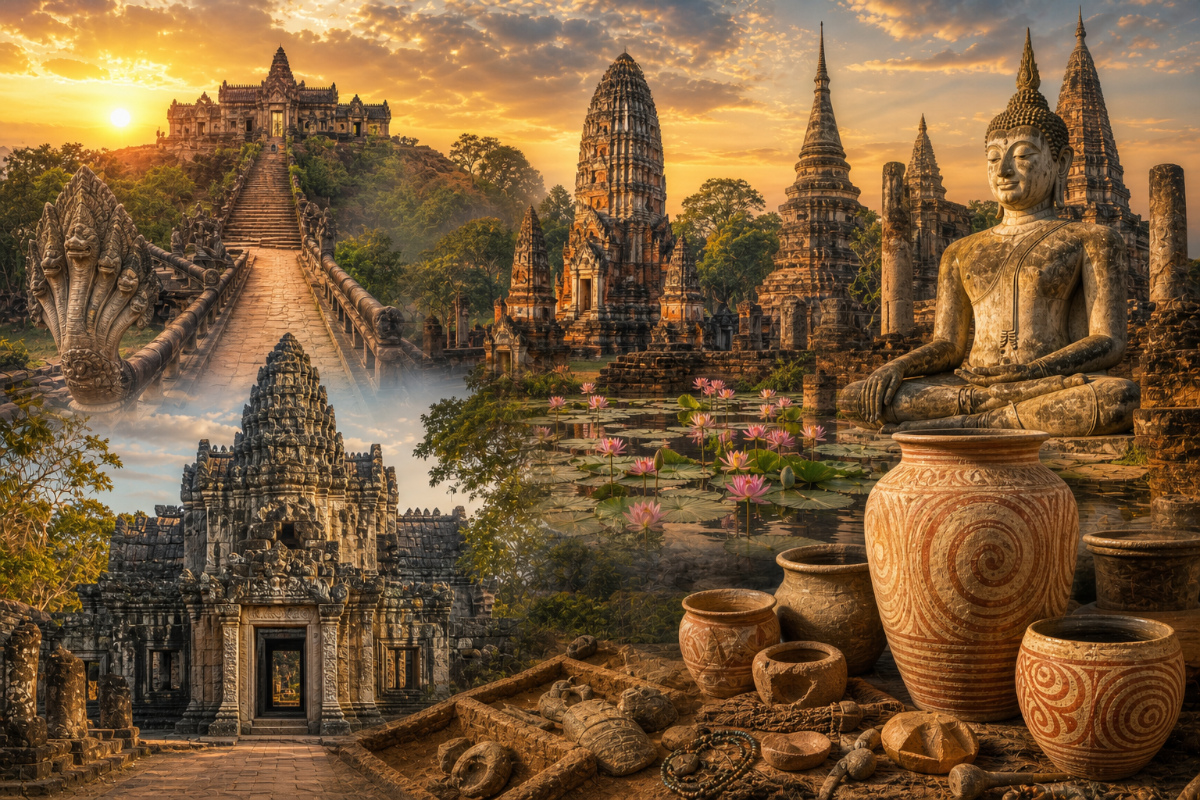
Thailand’s islands and energetic cities attract most of the attention, but its historic ruins reveal a deeper side of the country. Scattered across forested hills, provincial towns, and former capitals are temples, palaces, burial grounds, and monuments that span thousands of years.
Exploring the Ancient Sites in Thailand provides context for everything you encounter elsewhere, from Bangkok’s temple architecture to the cultural traditions of the northeast. Some locations are easy day trips, while others require long train journeys or regional flights. The effort is worthwhile.
Here are five places that deserve a spot on your itinerary.
1. Ayutthaya: The Most Accessible of the Ancient Sites in Thailand
Located north of Bangkok, Ayutthaya is the easiest historical city to include in a typical Thailand itinerary. It was founded in 1350 and became the second capital of the Siamese Kingdom. Between the 14th and 18th centuries, it developed into a major centre of international trade and diplomacy.
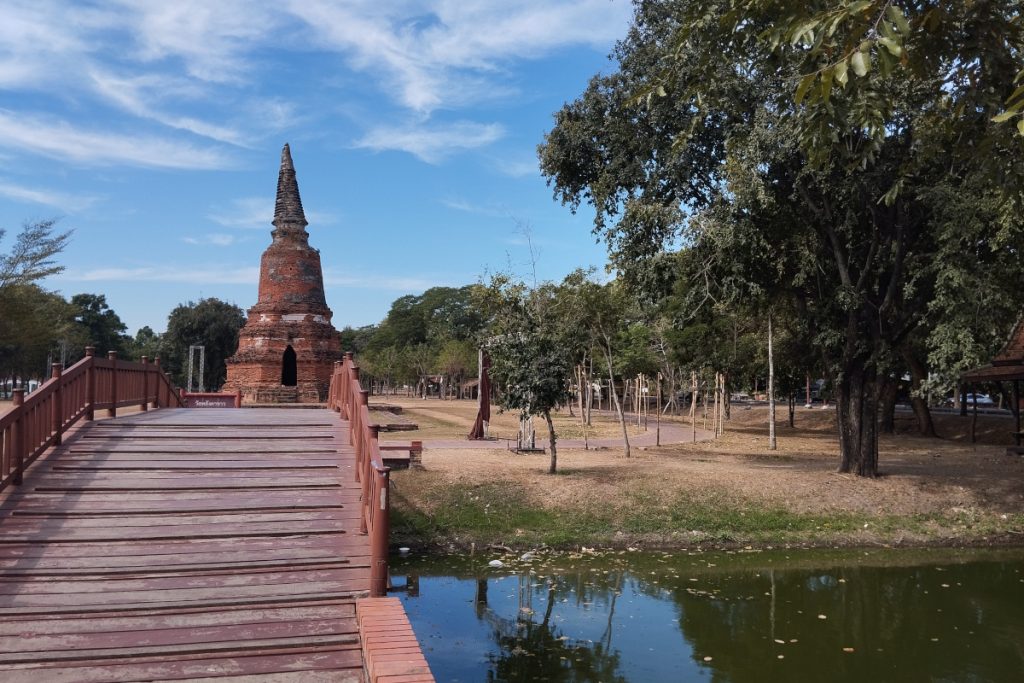
The city occupied an island surrounded by three rivers, creating natural protection while connecting it to maritime trading routes. Merchants and diplomatic missions arrived from China, India, Persia, Japan, and Europe. At its height, Ayutthaya was one of the world’s largest and most cosmopolitan cities. It was attacked and destroyed by a Burmese army in 1767 and was never rebuilt in the same location.
Today, the ruins are scattered around the historical park and modern city. Wat Mahathat is the best-known temple because of the stone Buddha head entwined within tree roots. It attracts large crowds, so arrive shortly after opening if you want to experience it without tour groups.
Nearby Wat Ratchaburana has a tall central prang and a crypt containing surviving mural paintings. Wat Phra Si Sanphet, once part of the royal palace complex, is recognised by its three large chedis. Across the river, Wat Chaiwatthanaram is particularly beautiful in the late afternoon.
You can reach Ayutthaya from Bangkok by train, minivan, taxi, or organised tour. Travelling independently gives you more control over your schedule. Once there, rent a bicycle, hire a tuk-tuk, or use a ride-hailing service to travel between the ruins.
A day trip covers the main temples, but staying overnight is better. You can explore early, take a break during the hottest hours, and return to the ruins when the light becomes softer.
2. Sukhothai: The Most Atmospheric of the Ancient Sites in Thailand
Sukhothai feels calmer and more spacious than Ayutthaya. Its monuments are surrounded by ponds, lawns, trees, and quiet country roads, making it one of the best places in Thailand to explore by bicycle.
Sukhothai served as the political capital of the first Kingdom of Siam during the 13th and 14th centuries. Together with Si Satchanalai and Kamphaeng Phet, it forms a UNESCO World Heritage property that illustrates the emergence of a distinctive style of Thai art and architecture. (whc.unesco.org)
The historical park is divided into several zones. Most visitors concentrate on the central area, where you will find Wat Mahathat. Once the spiritual centre of the kingdom, this enormous complex contains lotus-bud chedis, columns, Buddha images, and the remains of assembly halls.
Wat Sa Si occupies a small island reached by a footbridge. Its reflection in the surrounding pond makes it especially photogenic around sunrise and sunset. Wat Si Sawai, with its three Khmer-style towers, demonstrates the cultural influences that existed before Sukhothai developed its characteristic architectural identity.
Outside the central zone, Wat Si Chum contains a huge seated Buddha enclosed within a stone structure. The narrow opening reveals the statue gradually as you approach, creating one of the park’s most memorable views.
Renting a bicycle is the easiest and most enjoyable way to explore. The main roads are generally flat, and many guesthouses provide rentals. Bring water, sunscreen, and a hat because shade is limited in some areas.
Spend at least one full day in the park. If you have additional time, travel to Si Satchanalai, which served as a spiritual centre and an important ceramics-producing town. It receives fewer visitors and feels noticeably less developed.
3. Phimai: One of the Best-Preserved Khmer Ancient Sites in Thailand
Many travellers associate Khmer architecture entirely with Cambodia, but the Khmer Empire once influenced large parts of what is now northeastern Thailand. Phimai Historical Park is one of the clearest examples of that shared regional history.
Located in Nakhon Ratchasima Province, Phimai was connected to Angkor by an ancient road. Its sanctuary is oriented toward the southeast, broadly in the direction of the former Khmer capital.
The central temple complex is compact enough to explore in a few hours but detailed enough to reward a slow visit. Walk through its gateways, courtyards, galleries, and sandstone towers while paying attention to the lintels and religious carvings.
The central sanctuary combines Hindu architectural ideas with evidence of Mahayana Buddhist use. This mixture makes Phimai more interesting than a collection of beautiful ruins, it demonstrates how beliefs, artistic traditions, and political influence travelled across mainland Southeast Asia.
Phimai is about 60 kilometres from Nakhon Ratchasima city, also known as Korat. Public transport is available, but hiring a driver is more convenient if you want to visit other attractions in the area.
The modern town surrounding the park is relaxed and easy to navigate. Stay for lunch after exploring the ruins rather than immediately returning to Korat. You will find local restaurants and markets within walking distance.
Phimai rarely feels as crowded as Ayutthaya. Arrive in the morning, when temperatures are cooler and the sandstone takes on a warm colour. Dress respectfully because the complex retains religious and cultural significance.
4. Phanom Rung: The Most Dramatic of the Ancient Sites in Thailand
Phanom Rung stands on the rim of an extinct volcano in Buriram Province. The elevated position, monumental staircase, and long processional walkway make the approach almost as impressive as the sanctuary itself.
Constructed primarily from sandstone and laterite, the complex was originally dedicated to the Hindu god Shiva. Its design symbolically represents Mount Kailash, believed in Hindu tradition to be Shiva’s home.
Visitors approach by climbing a broad stone staircase and crossing a processional walkway lined with pillars. A naga bridge marks the transition from the earthly world into the sacred sanctuary. Beyond it, further steps lead to courtyards, galleries, and the central tower.
The carvings are among the highlights. Lintels and pediments depict Hindu deities, mythological creatures, and episodes from religious stories. Move slowly around the complex because many of the finest details are above doorways or tucked into corners.
On particular days of the year, the rising or setting sun shines through the sanctuary’s aligned doorways. These events attract large crowds, but the temple is impressive regardless of whether you visit during the solar alignment.
Phanom Rung is difficult to reach without private transport. The easiest option is to stay in Buriram and hire a driver for the day. Combine the visit with nearby Prasat Muang Tam, a smaller Khmer sanctuary featuring peaceful courtyards and L-shaped ponds.
Start early to avoid the afternoon heat. The exposed hilltop can become extremely hot, and there is relatively little shade inside the main complex. Carry water and wear shoes suitable for climbing uneven stone steps.
5. Ban Chiang: The Most Unusual of the Ancient Sites in Thailand
Ban Chiang is different from Thailand’s grand ruined capitals and Khmer sanctuaries. Instead of monumental towers, it offers evidence of prehistoric settlement, agriculture, pottery production, burial customs, and metalworking.
Located in Udon Thani Province, Ban Chiang is considered one of the most important prehistoric settlements discovered in Southeast Asia. Archaeological investigations revealed layers of human habitation spanning approximately two thousand years. The earliest layers date to around 1500 BCE and contain evidence connected to farming and the development of metal tools.
The site is especially famous for its distinctive red-painted pottery. Swirling patterns decorate bowls and vessels that have become visual symbols of the region.
Begin at the Ban Chiang National Museum, where exhibits explain the settlement’s development and display pottery, tools, jewellery, skeletons, and other objects recovered during excavations. Seeing the museum first makes the nearby archaeological areas much easier to understand.
This is not a destination for travellers looking for towering ruins or dramatic photographs. Much of Ban Chiang’s importance lies underground or behind glass. You need time to read the displays and imagine how ordinary people lived, farmed, created tools, and buried their dead thousands of years ago.
Ban Chiang can be visited as a day trip from Udon Thani. Hiring a car and driver is the most straightforward option, particularly if you want to explore other places in the province.
Planning Your Trip
Do not try to visit all five places in a few days. Ayutthaya works well as a trip from Bangkok, while Sukhothai deserves at least two nights. Phimai and Phanom Rung can be combined during a longer journey through northeastern Thailand, and Ban Chiang fits naturally into an Udon Thani itinerary.
Thailand’s tropical heat can make archaeological parks exhausting. Visit early, carry water, wear breathable clothing, and rest during the middle of the day. Cover your shoulders and knees at places that continue to have religious significance.
Most importantly, slow down. These destinations become far more meaningful when you stop treating them as backgrounds for photographs and start looking at the carvings, city layouts, religious symbolism, and landscapes that shaped them.
Learn More about Ancient Sites in Thailand

- 4 Lessons
- 1 Students
Learn about Thailand and turn your wanderlust into a well-planned adventure, travel smarter, cheaper, and with less stress.
- Know what you need to know
- Avoid rookie mistakes
- Tools to plan like a pro
- Unlock hidden gems