





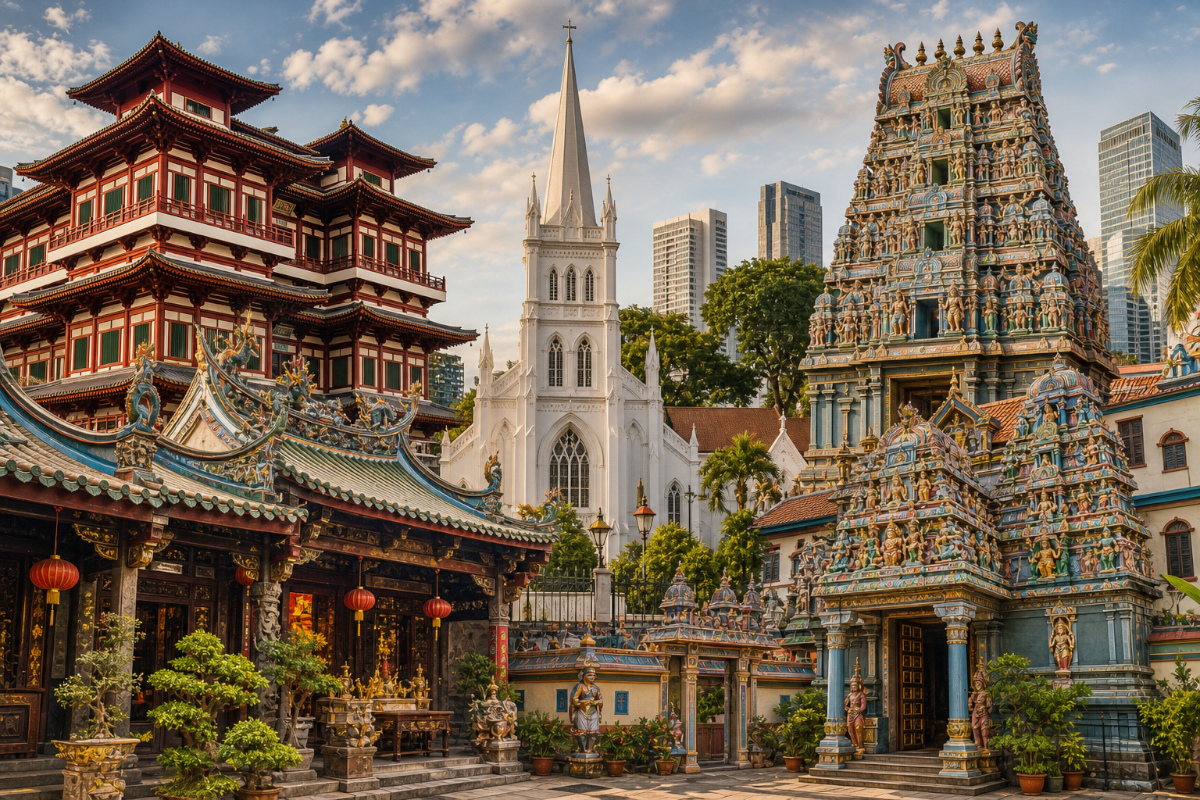
Singapore is famous for its skyline, shopping malls, hawker centres, and impossibly efficient public transport. But beneath the polished surface is a city shaped by faith. Chinese, Indian, Buddhist, Hindu, and Christian communities have all left their mark here, often within a few streets of one another.
That makes Singapore one of the easiest places in Asia to explore religious architecture. You can visit an ornate Hindu temple before lunch, walk past a historic Chinese shrine in the afternoon, and finish the day inside a Gothic cathedral, all without needing a taxi.
The five temples in Singapore below are among the most worthwhile sacred sites to visit in Singapore. One clarification: St Andrew’s Cathedral is not a temple, but it is one of the city’s most important historic places of worship and belongs on this list because of its architecture, heritage, and central location.
Entrance prices below were checked for July, 2026. All five sites currently offer free general entry, although donations, special services, or guided experiences may have separate arrangements.
1. Buddha Tooth Relic Temple and Museum
Location: 288 South Bridge Road, Chinatown
Entrance fee: Free
Opening hours: Temple and museum generally open daily, 7:00am–5:00pm
The Buddha Tooth Relic Temple is the most visually dramatic religious building on this list. Located in the heart of Chinatown, its red façade, sweeping rooflines, gold details, and layered design make it look older than it is. The temple opened in 2007, but its Tang Dynasty-inspired architecture gives it the presence of a much older monument. (buddhatoothrelictemple.org.sg)
Inside, the building is calmer than the exterior suggests. The main halls contain large Buddhist images, ceremonial decorations, and spaces for worship. The temple was built to house a sacred tooth relic associated with the Buddha, which is kept in a relic chamber on the upper levels.
The museum sections are worth your time, particularly if you are interested in Buddhist art, ritual objects, and the history of relic worship across Asia. You do not need to be Buddhist to appreciate the building. It works equally well as a cultural stop, an architectural visit, or a quiet place to escape Chinatown’s crowds.
The temple has a strict dress code. Avoid shorts, miniskirts, bare backs, low-cut tops, and off-the-shoulder clothing. Non-vegetarian food and pets are not permitted inside.
Best time to visit: Go early in the morning, when the surrounding streets are quieter and the temple feels more devotional than touristy. Afterwards, walk to Maxwell Food Centre for breakfast or lunch.
Why visit: This is the best temple in Singapore for architecture, photography, and a first introduction to Buddhist culture.
2. Sri Srinivasa Perumal Temple
Location: 397 Serangoon Road, Little India
Entrance fee: Free
Opening hours: Daily worship hours vary; morning and evening prayer periods are the best times to visit
Sri Srinivasa Perumal Temple is one of the most important Hindu temples in Singapore and a major centre of Vaishnavite worship. Dedicated to Lord Vishnu, it stands along Serangoon Road in Little India, an area where the smell of jasmine, incense, curry, and freshly fried snacks seems to follow you from one street to the next.
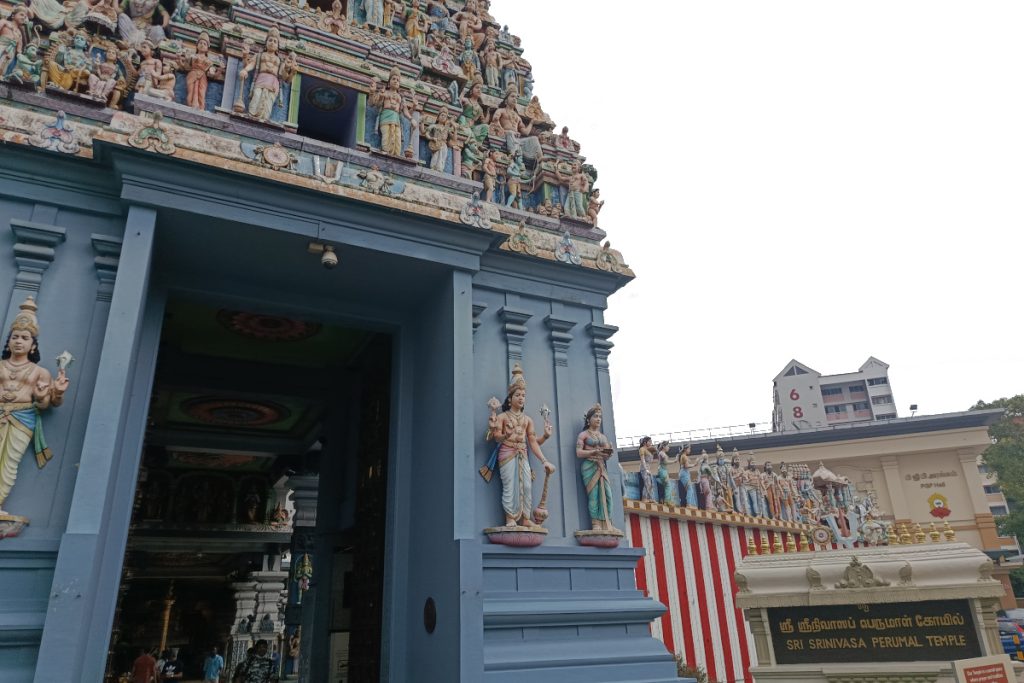
The temple’s entrance is marked by a tall and richly decorated gopuram, or gateway tower, covered with colourful figures of Hindu deities. Inside, the atmosphere is more intimate than the monumental façade suggests. Devotees arrive to pray, make offerings, and participate in daily rituals.
Unlike some heritage buildings that feel frozen in time, Sri Srinivasa Perumal Temple is very much a living place of worship. The daily prayer schedule includes morning and evening ceremonies, and visitors may see worshippers receiving blessings or carrying out traditional offerings. The temple’s official schedule lists morning prayer and archana periods, as well as evening worship.
The temple is also closely associated with Thaipusam, one of Singapore’s most striking Hindu festivals. During the procession, devotees traditionally begin at Sri Srinivasa Perumal Temple before travelling through the city towards Sri Thendayuthapani Temple. It is a powerful reminder that Singapore’s religious heritage is not merely displayed for visitors, it is actively practised.
Dress modestly, remove your shoes where instructed, and avoid stepping into areas reserved for worshippers. Photography may be restricted during ceremonies, so look for signs and follow the instructions of temple staff.
Best time to visit: Late afternoon or early evening, when Little India is lively and the temple’s evening rituals begin.
Why visit: This is the place to experience Hindu worship as a living tradition rather than simply admire historic architecture.
3. St Andrew’s Cathedral
Location: 11 St Andrew’s Road, near City Hall
Entrance fee: Free
Operating hours: Generally 7:00am–8:00pm; the Welcome Centre is open Tuesday to Saturday, 10:00am–4:00pm
St Andrew’s Cathedral is Singapore’s oldest Anglican cathedral and one of the clearest examples of colonial-era Gothic architecture in the city. It is not a temple, but leaving it out of a list of Singapore’s most important sacred sites would make little sense.
The white building stands beside City Hall and the National Gallery, surrounded by traffic, office towers, and constant movement. Walk through the gates, however, and the mood changes almost immediately. The cathedral grounds offer a surprisingly peaceful pause in the centre of the city.
Inside, look for the high vaulted ceiling, pointed arches, stained-glass windows, and cool interior that provides welcome relief from Singapore’s heat. The architecture is restrained compared with the colourful Hindu and Buddhist temples in Singapore, but that simplicity is part of its appeal.
The cathedral’s Welcome Centre is open to visitors and provides information about the building’s history, Christian worship, and heritage. Regular guided tours last approximately one hour and are free, although advance booking is recommended.
Try to visit outside service times if you want to explore quietly. If a service is taking place, enter respectfully, remain at the back, and avoid photography unless clearly permitted.
Best time to visit: Mid-morning on a weekday, when the surrounding Civic District is less crowded.
Why visit: It is a peaceful historic landmark and an excellent contrast to Asian temples in Singapore.
4. Thian Hock Keng Temple
Location: 158 Telok Ayer Street, Downtown Singapore
Entrance fee: Free
Opening hours: Daily, 7:30am–5:00pm; last entry at 4:45pm
Thian Hock Keng is one of Singapore’s most important Chinese temples and one of the city’s great heritage surprises. Today it stands among glass towers and office buildings in the Telok Ayer district. When the temple was first established, however, this area was close to the shoreline.
Hokkien immigrants arriving by sea came here to worship Mazu, the Chinese goddess of the sea, and give thanks for a safe journey. That history explains the temple’s name, commonly translated as “Palace of Heavenly Happiness,” and its strong connection to Singapore’s early Chinese communities.
The temple’s architecture is especially impressive. Look closely at the stone carvings, ceramic roof decorations, dragon motifs, timber details, and richly coloured panels. Many of the materials and decorative elements reflect traditional southern Chinese craftsmanship.
Thian Hock Keng is not huge, which makes it easy to visit in 20 to 30 minutes. The best approach is to slow down and notice the details rather than rush through for a photograph. Informational brochures and a virtual tour are available for individual visitors, while free guided tours are offered for organised groups and during selected events. (thianhockkeng.com.sg)
The temple is close to Lau Pa Sat, Chinatown, and the Ann Siang Hill area, so it fits easily into a walking route through central Singapore.
Best time to visit: Early morning, before the surrounding business district becomes busy.
Why visit: Thian Hock Keng connects Singapore’s modern financial district with the maritime and immigrant history that made the city what it is.
5. Sri Mariamman Temple
Location: 244 South Bridge Road, Chinatown
Entrance fee: Free
Opening hours: Morning, 6:00am–12:00pm; evening, 6:00pm–9:00pm, with later closing on Fridays
Sri Mariamman Temple is Singapore’s oldest among Hindu temples in Singapore and one of the most recognisable buildings on South Bridge Road. Founded in 1827 by Indian pioneer Naraina Pillai, it remains an active place of worship and a National Monument.
The first thing you notice is the colourful gopuram above the entrance. It is covered with rows of sculpted figures, each seemingly competing for your attention. Once inside, the temple becomes more intricate. Painted ceilings, carved columns, shrines, and ritual spaces fill the main hall.
The temple is dedicated to Sri Mariamman, a goddess associated with protection and healing. Other shrines honour deities including Ganesha, Rama, Draupadi, and Aravan. During services and festivals, the building becomes even more vibrant, with flowers, music, offerings, and devotees moving through the halls.
Sri Mariamman is also famous for Theemithi, Singapore’s annual fire-walking ceremony. The event honours Draupadi and forms part of a larger religious celebration that includes a procession from Sri Srinivasa Perumal Temple in Little India to Sri Mariamman Temple.
Because the temple is in the middle of Chinatown, it is easy to combine with the Buddha Tooth Relic Temple, Jamae Mosque, Chinatown Street Market, and the nearby food stalls. Just remember that this is a functioning temple, not a museum. Keep your voice low, dress respectfully, and do not interrupt worship.
Best time to visit: Early morning or around the evening opening, when the temperature is cooler and worship is active.
Why visit: Sri Mariamman is the best place to see Singapore’s Tamil Hindu heritage in a compact, colourful, and deeply historic setting.
Practical Tips for Visiting Temples in Singapore
- Dress modestly. Cover shoulders and knees, especially at Hindu and Buddhist temples in Singapore.
- Remove your shoes before entering areas where signs or temple staff require it.
- Avoid photographing ceremonies unless permission is clearly given.
- Visit early or late. Singapore is hot, and these sites are often more peaceful outside the middle of the day.
- Bring small notes or coins if you want to make a donation, though entry itself is free.
- Use the MRT. Chinatown, Maxwell, City Hall, Little India, and Telok Ayer are all well connected.
A Simple One-Day Route for this 5 Temples in Singapore
Start at Sri Srinivasa Perumal Temple in Little India, then take the MRT to City Hall for St Andrew’s Cathedral. Continue to Thian Hock Keng Temple in Telok Ayer, and finish in Chinatown with Sri Mariamman Temple and the Buddha Tooth Relic Temple.
It is a full day, but it gives you a better understanding of Singapore than another afternoon in a shopping mall ever could.
Learn more about Temples in Singapore
- 4 Lessons
- 1 Students
Learn about Singapore and turn your wanderlust into a well-planned adventure, travel smarter, cheaper, and with less stress.
- Know what you need to know
- Avoid rookie mistakes
- Tools to plan like a pro
- Unlock hidden gems